

Peerfolio doesn't want your money
When a crypto company fails or experiences a major hack, its customers usually find out the same way: the withdraw button stops working. The company was holding their money, so its problems became their problems.
Peerfolio is built so that can't be how your story ends. We help you grow your wealth with crypto, and your funds sit in accounts you own on a public blockchain. We can't withdraw them, and you can export your accounts and take your money elsewhere without asking our permission.
You also won't have to memorize a recovery phrase, and you can sign up with just your email or phone. This article explains how both things can be true, what Peerfolio can and can't do with your money, and where the risks remain.
Dilemma
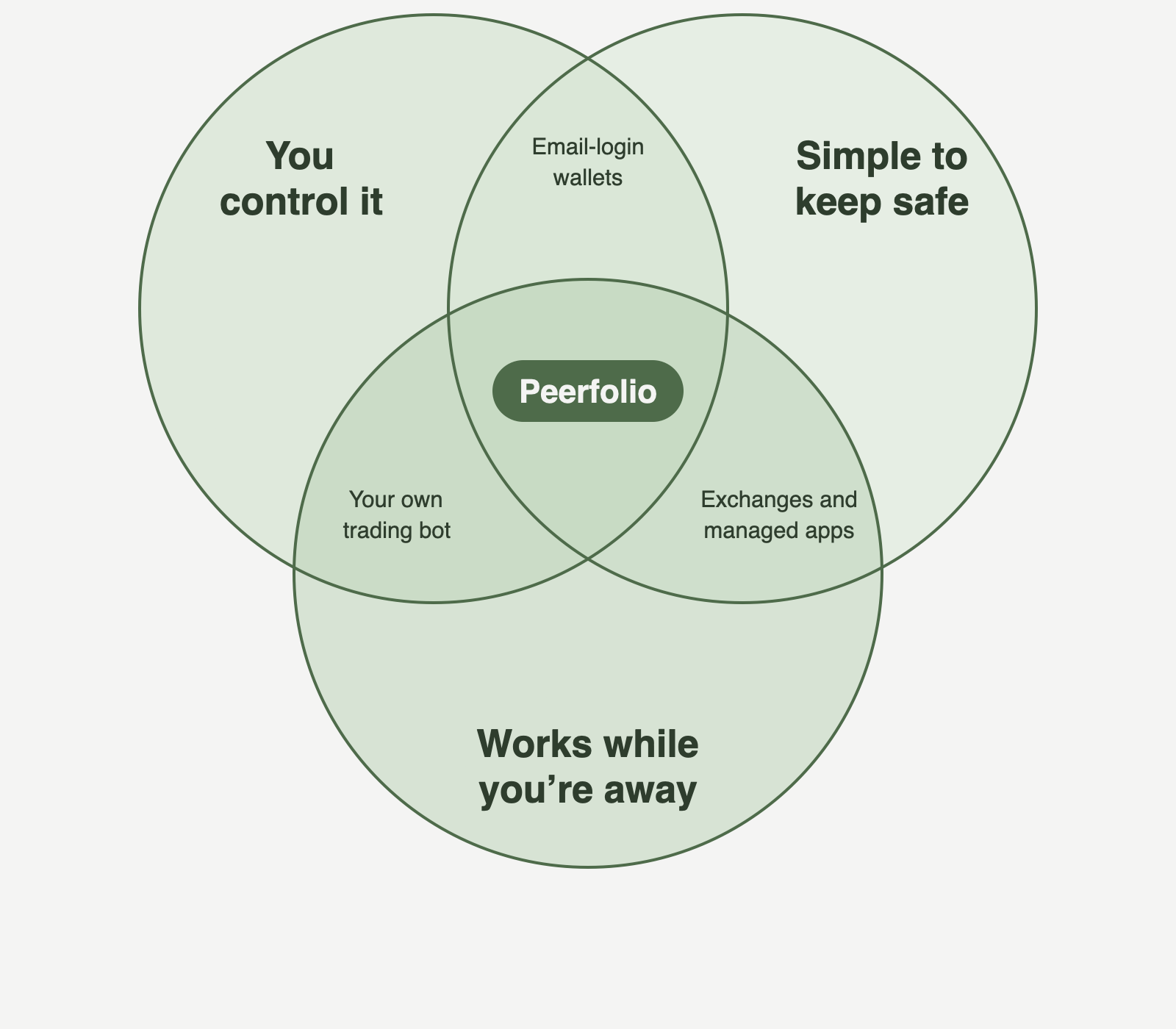
Every action on a blockchain has to be signed with a private key, a long secret that works like the only password to your money. Most crypto products make you choose how to handle it:
- Keep it yourself. You own your money outright, but key management is not for the faint of heart. You have to back up a long recovery phrase, keep it safe from fire, theft and prying eyes for years, and never type it into the wrong website. Lose it and nobody can get your money back. Leak it and your money can be taken.
- Let a company keep it. Signing up is easy and a lost password can be reset, but the company is holding your money, and you depend on it staying honest and solvent.
We wanted you to own your money without carrying that burden.
Your main account: you own the key, and never have to see it
When you sign up, our wallet provider Privy creates a wallet for you and splits its key into pieces, a technique called key sharding. Think of a vault that needs several keys turned at once: no single piece opens it. Privy only puts the key together when you log in, inside a sealed, tamper-resistant part of a computer (a Trusted Execution Environment), and only for long enough to sign what you've approved.
This is your main account. It's created when you sign up, it belongs to you alone, and Peerfolio never holds its key. Privy lets you log in using your email or phone to access the account.
How Peerfolio trades for you without holding your money
Trades don't always finish the moment you tap a button, and you shouldn't have to keep the app open or approve every step. So something needs to carry out your trades for you. An always-on system like that is usually a system that holds your money. Ours doesn't.
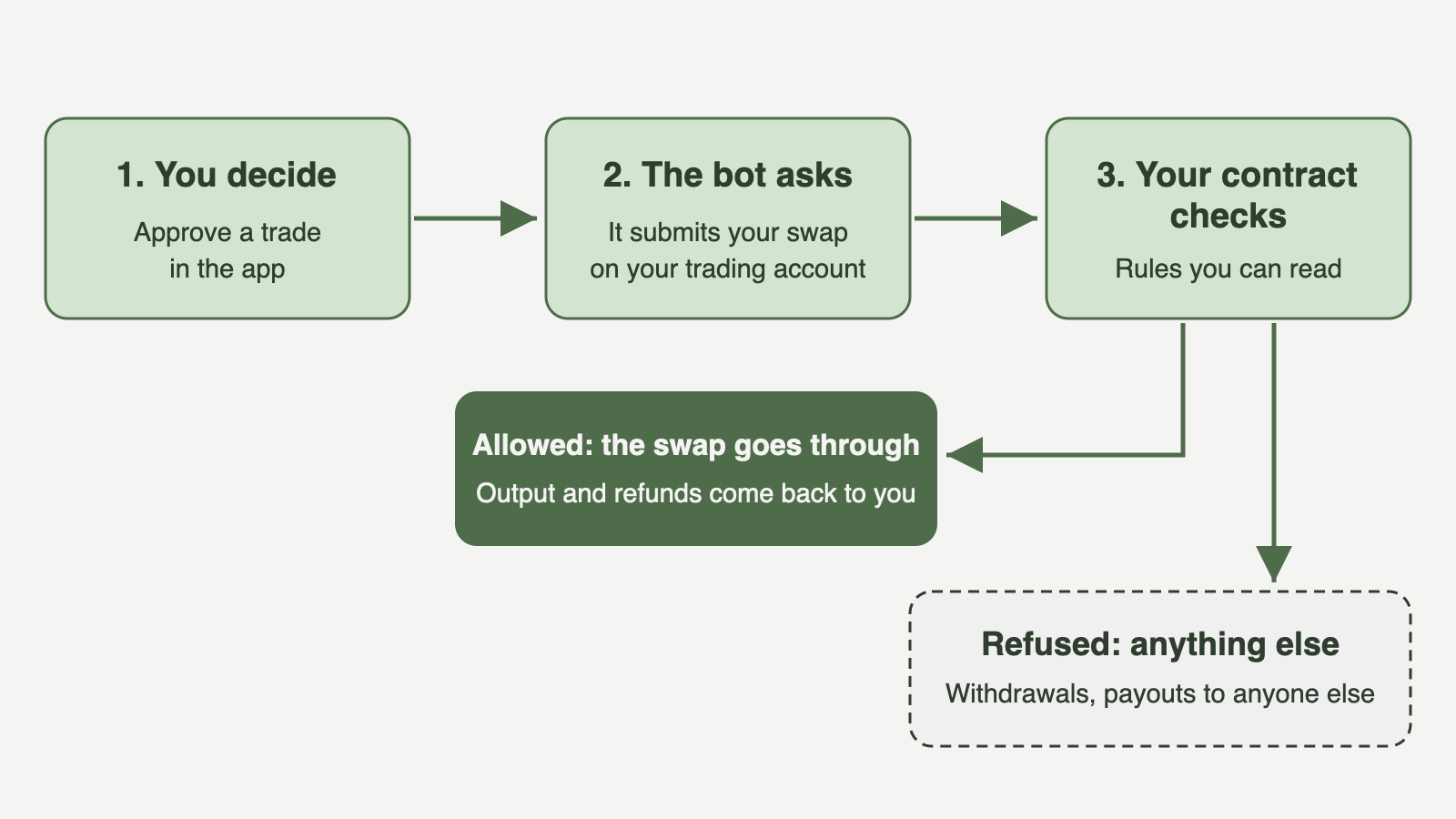
That's why Peerfolio gives you a second account. During setup, your main account creates a trading account, a small program on the blockchain (a smart contract) that your main account owns. Think of it as a separate pot for trading: you choose how much to move into it, and the rest stays in your main account, out of our bot's reach. You then sign one transaction giving the Peerfolio bot permission to work with that pot, and only that pot.
The rules live in the contract, not on our servers, so they hold even if our servers misbehave. The code is public, so anyone can verify it.
The bot can only trade
Peerfolio can't withdraw your money. The only thing our bot can do with your tokens is trade them on the marketplace: swapping one token for another. The contract's job is to make sure that whatever the bot does, your money stays in your accounts.
Outside of trades, your funds can only move between your own accounts. The bot can return them to your main account, and that's the only other place they can go.
The contract enforces the limits:
- Trade proceeds only go to you. The output, and any refund from a failed trade, can only go to your trading account or your main account.
- No big price gaps. It won't accept a swap with more than a certain allowed slippage; the gap between the quoted price and the final one.
- No changing its own rules. New contract code only reaches your account if you sign for it, and you can remove the bot at any time, effective immediately.
What you still need to watch for
Crypto prices move. Nothing in this design protects you from the market going down.
You rely on our providers. Privy secures your login and key, and our swap provider prices and fills your trades.
Read before you approve. A malicious script on any website could try to ask you to sign something. We limit where scripts can load from, and we keep the token that authorizes signing away from our backend servers. Every signature goes through our open-source approval screen, which describes the transaction in plain language and warns you about risky ones. It's the last check, and it's yours.
Expect a few more taps. You'll be asked to approve things more often than in a typical app, much like confirming a payment in your banking app. It can feel abrupt if you're new to crypto, and we're working to make it smoother. We won't remove the step, though: that tap is what keeps the decision with you.
No walled garden
This is the real test of whether a company holds your money. You can export both of your accounts and move your assets to cold storage, an exchange, or any wallet you prefer, without asking us.
We built Peerfolio for the people we care about: the parent who asks whether crypto is safe, the friend who gave up because it seemed complex. We want them to own what they earn, and we'd never ask them to hand it to us for safekeeping. So we made sure they never have to.
Get started on Peerfolio and see for yourself.
Comments
Join the discussionNo comments yet. Be the first to comment.
